
Financial position
Objectives and principles of financial management
A key objective of the financial management of the Carl Zeiss Meditec Group is to safeguard liquidity and increase this efficiently throughout the Group.
For the Carl Zeiss Meditec Group, operative business is the main source of liquidity for the individual business units, which is also reflected in its strategic orientation and financial activities. In fiscal year 2023/24, a one-off loan of €400m was also taken out from the ZEISS Group in connection with the DORC acquisition for partial financing of the transaction. Carl Zeiss Meditec AG operates a global financial management system that covers all of its subsidiaries and is centrally organized at Group level. For this purpose, services are obtained from the Group Treasury of Carl Zeiss AG. The Carl Zeiss Meditec Group also strives to continuously improve its financial power and reduce financial risks by keeping a constant check on the solvency of its debtors, which also involves the use of financial instruments.
The Company deposits any liquidity it does not require with the treasury of Carl Zeiss AG at normal market conditions. When investing surplus liquidity, short-term availability generally takes priority over the goal of maximizing earnings, so that funds can be accessed quickly if, for example, acquisition opportunities arise. The Carl Zeiss Meditec Group has production plants in the US, Europe and China. This allows the Group to mitigate the effect of exchange rate fluctuations. The remaining currency risk is hedged by futures trading. Details on this can be found in the notes to the consolidated financial statements under 2 “Accounting and valuation principles” and 26 “Financial instruments and risk management”, and in the annual financial statements of Carl Zeiss Meditec AG under “Information and explanatory notes on accounting and valuation principles and notes to individual items in the balance sheet”, Section 12 “Provision” and 7 “Receivables and other assets”.
Financial management
The ratio of borrowed capital to equity amounts to 60.0% as of 30 September 2025 (prior year: 65.0%).
Furthermore, the Company has the option to take out loans, either from the treasury of Carl Zeiss AG or from banks.
For further information on the financial liabilities of the Carl Zeiss Meditec Group please refer to note 23 “Financial liabilities”, 24 “Accrued liabilities” and 25 “Other non-financial liabilities” in the accompanying notes to the consolidated financial statements and in the annual financial statements of Carl Zeiss Meditec AG under 7 “Receivables and other assets” and 13 “Liabilities”.
As the Company possesses sufficient cash funds to finance its operating and strategic objectives, changes in credit conditions do not currently have any material effect on its financial position. The fixed interest rate of the loan from the ZEISS Group means that there are no changes to the conditions.
Separate reporting on financial instruments
The Carl Zeiss Meditec Group is exposed to currency fluctuation risks due to its international business activities in numerous different currencies. Significant currency risks are hedged against with hedging transactions, based on a rolling business plan.
Hedges are transacted centrally by Carl Zeiss Financial Services GmbH. The services provided by Carl Zeiss Financial Services GmbH to Carl Zeiss Meditec AG and its subsidiaries are regulated by corresponding general agreements. The hedges are processed by Carl Zeiss Financial Services GmbH with external business banks. Hedges are entered into solely via banks with high credit ratings given by leading agencies. The business transactions are executed with strict separation of functions between the front office (trade), middle office (financial risk management, controlling) and back office (processing, documentation).
Value-at-risk analyses, together with scenario, sensitivity and stress test analyses, are implemented in risk control and monitoring, to quantify the currency risks. Hedging rates are specified for operative control of all relevant currencies. Risk limitations were set in the form of limits with respect to counterparties and types of business. Derivative financial instruments are exclusively used for hedging purposes.
Statement of cash flows
The Carl Zeiss Meditec Group’s statement of cash flows shows the origins and utilization of the cash flows during a fiscal year. A distinction is made between cash flows from operating activities and cash flows from investing and financing activities.
Summary of key ratios in the statement of cash flows
in €m
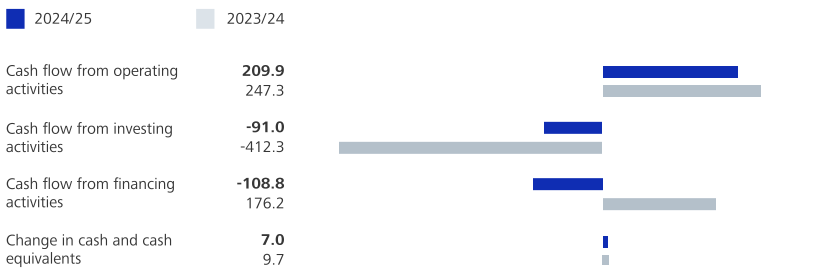
Cash flows from operating activities amounted to €209.9m in the fiscal year under review (prior year: €247.3m). The decline is due to the increase in working capital, particularly as a result of the change in trade receivables, as well as higher interest payments.
Cash flows from investing activities amounted to -€91.0m in fiscal year 2024/25 (prior year: -€412.3m). Investments in property, plant and equipment and intangible assets, including the expansion of production capacity for intraocular lenses and refractive consumables, as well as the increase in receivables from the Group treasury were significantly lower than in the prior year. Further cash inflows came from the sale of a plant as part of the conversion of production capacities in RTP production. In the prior year, in addition to the payment of the purchase price for the DORC acquisition, there was a high cash drawdown from the Group treasury and a corresponding reduction in treasury receivables.
Cash flows from financing activities amounted to -€108.8m in the fiscal year under review (prior year: €176.2m). The lower cash inflow in fiscal year 2024/25 resulted in particular from the reduction in liabilities to Group Treasury as well as dividend and lease payments. The basis for comparison in the prior year includes the loan taken out by the ZEISS Group and thus a cash inflow.
Free cash flow increased to €203.7m in fiscal year 2024/25 (prior year: €121.5m). The increase is mainly due to lower investments in property, plant and equipment and intangible assets as part of the resilience program launched in the 2023/24 fiscal year. Net cash1 also increased to €123.5m (prior year: €72.9m). Due to the loan taken out in connection with the DORC acquisition from the ZEISS Group in the previous year, net financial debt1 amounted to €276.9m (prior year: €327.4m)
Investment and depreciation policy
Continuous investments in both strategic business units are required to further consolidate the Company’s market position in the medical technology sector. A distinction is made between two types of investment: capacity expansions and replacement investments. These investments are primarily financed from cash flows from operating activities.
The production of devices and systems by the Company is generally restricted to the integration of individual components to create system solutions. Investments in property, plant and equipment at Carl Zeiss Meditec Group level are thus comparatively low. One exception is the production of intraocular lenses and surgical consumables, which generally demands higher investments due to a larger vertical range of manufacture.
Nevertheless, the required investment of capital in property, plant and equipment is limited within the Company, which is evident from the development of the capex ratio – the ratio of total investments2 in intangible assets and property, plant and equipment (cash) to consolidated revenue. In fiscal year 2024/25, it amounted to 3.4% (prior year: 7.4%), partly due to significantly lower investments at higher revenue.
At Carl Zeiss Meditec AG and its subsidiaries, intangible assets and property, plant and equipment are subject to scheduled, straight-line amortization and depreciation, respectively, over their estimated useful lives. Further details on this can be found in note 2 “Accounting and valuation principles” in the “Other intangible assets” section, and under “Property, plant and equipment” in the accompanying notes to the consolidated financial statements and in note 4 “Fixed assets” in the annual financial statements of Carl Zeiss Meditec AG.
|
|
|
|
30 Sep 2025 |
|
30 Sep 2024 |
|
Change |
|---|---|---|---|---|---|---|---|---|
Key ratio |
|
Definition |
|
€m |
|
€m |
|
in % |
Cash and cash equivalents |
|
Cash-in-hand and bank balances |
|
27.3 |
|
20.3 |
|
+34.4 |
Net cash and cash equivalents |
|
Cash-in-hand and bank balances |
|
123.5 |
|
72.9 |
|
+69.3 |
Net financial debt |
|
Cash-in-hand and bank balances |
|
-276.9 |
|
-327.4 |
|
-15.4 |
Net Working Capital |
|
Current assets including financial investments |
|
613.0 |
|
570.7 |
|
+7.4 |
Working Capital |
|
Current assets |
|
736.5 |
|
643.6 |
|
+14.4 |
|
|
|
|
|
|
|
|
|
Key ratio |
|
Definition |
|
2024/25 |
|
2023/24 |
|
Change |
Cash flow per share |
|
Cash flows from operating activities |
|
€2.40 |
|
€2.78 |
|
-13.9% |
|
Weighted average number of shares outstanding |
|
|
|
||||
Capex ratio |
|
Investment (cash) in tangible- and intangible assets |
|
3.4% |
|
7.4% |
|
-4.0% pts |
|
Revenue of Carl Zeiss Meditec Group |
|
|
|
1 As defined in the “Key ratios relating to financial position” table.
2 In fiscal year 2024/25, total investments amounted to €76.6m, compared with €152.2m in the prior year.