
Carl Zeiss Meditec Group
Group structure
The Carl Zeiss Meditec Group (hereinafter the Company, the Group) is an international company headquartered in Jena, Germany, with additional subsidiaries in and outside of Germany. Carl Zeiss Meditec AG is the parent company of the Carl Zeiss Meditec Group and is listed in the MDAX and TecDAX on the German Stock Exchange.
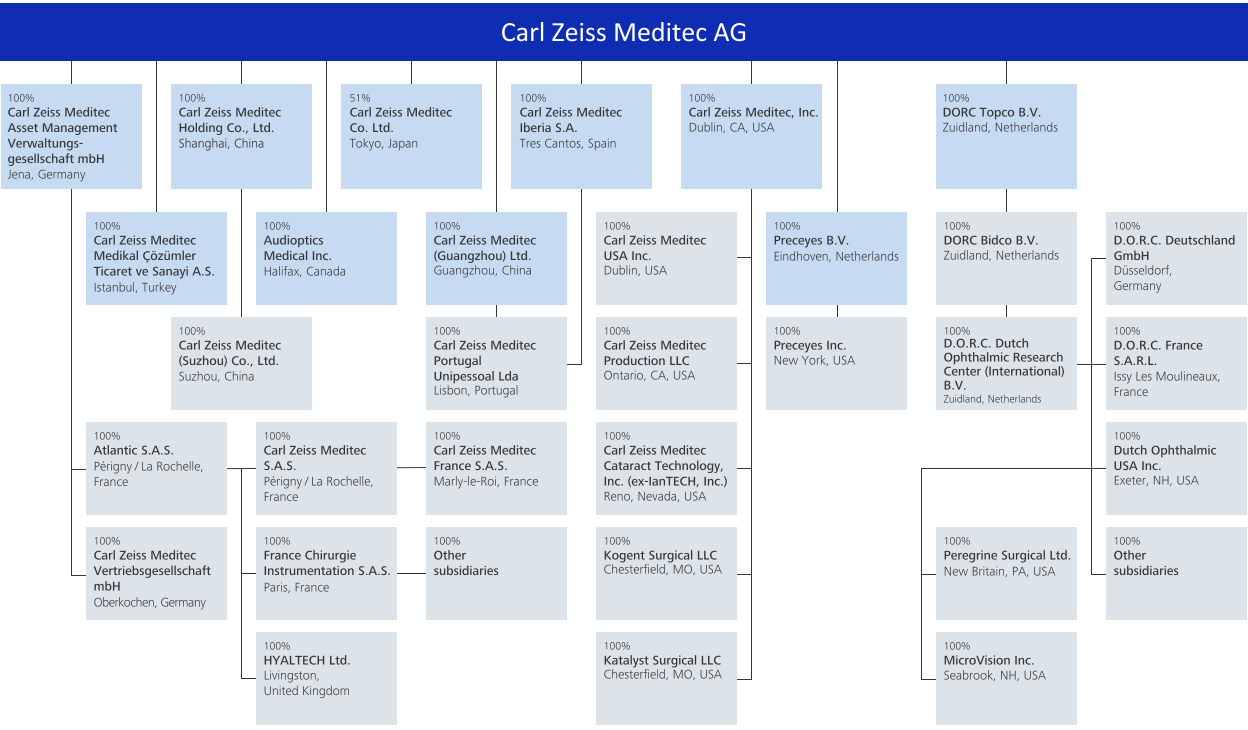
The results of Carl Zeiss Meditec AG are influenced to a large extent by its subsidiaries, and the development of its business is generally subject to the same opportunities and risks as the Carl Zeiss Meditec Group. The outlook for the Group also largely mirrors the expectations for Carl Zeiss Meditec AG, due to the links between Carl Zeiss Meditec AG and its subsidiaries and due to the importance of Carl Zeiss Meditec AG within the Group. Therefore, for the purposes of a more compact presentation, the business development of Carl Zeiss Meditec AG and the Carl Zeiss Meditec Group have been presented in the form of a summary management report. Major investments of the Carl Zeiss Meditec Group as of 30 September 2025 are presented in the chart below.
Ownership structure of the Carl Zeiss Meditec Group as of 30 September 2025
Markets
With its headquarters in Jena (Germany) and additional plants and subsidiaries in, among others, Germany, France, the Netherlands, Spain, the US, Japan and China, the Carl Zeiss Meditec Group has a direct presence in key medical technology markets. The Carl Zeiss Meditec Group also utilizes the distribution network of the ZEISS Group1, with its more than 60 sales and service locations and more than 30 production sites, thus ensuring itself customer proximity in international competition. Aside from its own research and development locations, the Carl Zeiss Meditec Group also has access to the expertise of the ZEISS Group. Of the more than 30 research and development locations of the ZEISS Group worldwide, China and India, in particular, are important development centers. They offer the possibility of working with the customers on site, in order to gain a better regional understanding of the market and develop specific products that are tailored to market requirements.
Organization and business activity
The field of activity of the Carl Zeiss Meditec Group is essentially divided into two main areas or Strategic Business Units (SBUs). The business fields are divided based on the areas of application and customer groups within Ophthalmology and Microsurgery. Therefore, a distinction is made between the Ophthalmology (OPT) SBU and the Microsurgery (MCS) SBU.
Ophthalmology
Within the Ophthalmology strategic business unit, the Carl Zeiss Meditec Group offers all essential types of medical products, from devices and consumables to implants, that are relevant for ophthalmic surgery and diagnostics.
For the diagnosis, treatment and monitoring of chronic eye diseases, the Carl Zeiss Meditec Group offers devices for general ophthalmological examination and care. In addition to slit lamps, refractometers and tonometers, the product portfolio also includes devices for optical coherence tomography (OCT) and fundus cameras, which are used in clinics and practices for examination of the retina. The Company also offers devices for functional glaucoma diagnostics (perimeters), The range of surgical ophthalmology products includes surgical microscopes, biometers and phacoemulsification and vitrectomy equipment. For cataract surgery, the Carl Zeiss Meditec Group also offers a range of intraocular lenses (IOLs). The product portfolio in the area of refractive surgery primarily includes systems and consumables for laser eye surgery. These include the VISUMAX® femtosecond laser, which enables minimally invasive correction of vision defects using lenticular extraction (SMILE®). In addition, digital products are offered that enable the storage, analysis, and sharing of clinical data.
Microsurgery
The Carl Zeiss Meditec Group’s strategic business unit Microsurgery offers products and solutions for minimally invasive surgical treatments. Customers include clinics and practices for neuro- and spinal surgery, ENT and reconstructive surgery, and dentistry. During surgical procedures, ZEISS solutions support intraoperative diagnostics and provide information that would otherwise not be visible to the human eye, such as that obtained using fluorescence modules.
The product portfolio includes surgical visualization, interoperative radiotherapy, interoperative pathology, special surgical instruments and digital solutions. Cross-product workflow solutions such as the ZEISS Tumor Workflow combine various products and technologies into a comprehensive solution which offers additional customer value beyond that of the individual products.
Group strategy
As an internationally positioned medical technology group, Carl Zeiss Meditec AG pursues a long-term growth strategy based on technological excellence, global presence, and consistent customer focus. The focus is on the two strategic business units Ophthalmology and Microsurgery, whose solutions set standards worldwide. A central element of the strategy is the consistent digitalization of clinical workflows. Intelligent, networked systems make diagnostic and therapeutic processes more efficient and improve interoperability between devices, software and data platforms. These digital solutions not only enable a higher quality of care, but also form the basis for implementing the workflow strategy, which takes a holistic view of the clinical process.
Research and development (R&D) are key to the Company’s innovative strength. Continuous investment in new technologies, platforms and applications will further strengthen the Company’s position as an innovation leader in ophthalmic surgery and microsurgery. In addition, the Carl Zeiss Meditec Group makes targeted use of M&A initiatives as a strategic tool to expand its portfolio, tap into new markets, and realize synergies. The inclusion of consumables is also becoming increasingly important as a means of strengthening customer loyalty and further intensifying the integration into clinical workflows. The combination of internal innovation, digital transformation, and external growth momentum creates sustainable value for patients, customers, and shareholders.
Corporate governance
The central governing body within the Carl Zeiss Meditec Group is the Management Board, consisting of the President and CEO and the CFO. The Management Board is supported by an extended management committee. In addition to the two members of the Management Board, this committee also includes the heads of the Ophthalmology and Microsurgery strategic business units, as well as the heads of the Operations, Human Resources and Digital functions. The management levels below the management committee perform their management responsibilities in accordance with the organizational structure across regions and Company locations. Cross-organizational functions, such as Finance or Communications, for example, are managed centrally. The strategies and projects are implemented locally by the country organizations, taking the prevailing laws, rules of procedure and bylaws, and the applicable corporate values and principles into account. The Management Board is responsible for reporting current issues and planned operational changes to the Supervisory Board on a regular basis, but at least quarterly. Collectively, the members of the Management Board, Supervisory Board and Extended Management Committee hold relevant experience for the sectors, products and geographical locations of the Carl Zeiss Meditec Group.
As a company of the ZEISS Group, the Carl Zeiss Meditec Group is also subject to the global Code of Conduct of the ZEISS Group. This stipulates the general rules of good and fair conduct in competition and when dealing with all employees and customers. The Code of Conduct sets out the fundamental ethical principles of good conduct and values which govern the actions of both management and employees in their day-to-day work at the Company.
Corporate management
The consistent implementation of the Group strategy aims to ensure a long-term increase in value. A comprehensive system of key performance indicators serves as a tool for the financial management of the Carl Zeiss Meditec Group. The greatest importance is attached to Economic Value Added® (EVA®)2, Free Cash Flow (FCF)3, EBITA4 and EBITA margin, and revenue growth. These control variables define the balance between growth, profitability and financial power upon which sustainable growth of the Company is built. These key financial performance indicators are therefore defined as the most significant control variables. These are supplemented by strategic measures and projects in the areas of customer excellence, people/performance culture and operational excellence.
The EBITA control parameter is only used for management purposes at the Group level, not at the level of the individual company Carl Zeiss Meditec AG; EVA® and FCF are only determined at the Group level, not at the segment level.
1 Carl Zeiss AG and all subsidiaries
2 Calculation: EVA® = operating result (EBIT) after taxes (Group tax rate 29.87%) plus write-downs on intangible assets arising from purchase price allocations in the amount of €34.4m less cost of capital in the amount of €246.4m for fiscal year 2024/25. (calculation of cost of capital: average capital employed, adjusted for write-downs on intangible assets arising from purchase price allocations (“gross” asset basis) (2024/25: €2,433.2m, multiplied by the cost of capital rate (2024/25: 10.4%)).
3 Calculation: Free cash flow (FCF) = EBIT ± changes in trade receivables ± changes in inventories including advance payments ± changes in provisions (excluding provisions for pensions and provisions for taxes) ± changes in current accrued liabilities ± changes in trade payables ± changes in advance payments received ± changes in leasing liabilities ± changes in other assets and liabilities – increase in investment in property, plant and equipment (incl. additions to rights of use) and intangible assets + write-downs on intangible assets and property, plant and equipment – acquisition of investments.
4 Calculation: EBITA = EBIT + amortization of purchase price allocations on intangible assets